Tuesday, 17 May 2011

Are you assuming your supporters can't read?!

Of late I feel I have walked in to a phase of poor customer care (as you may recall from a previous post), and sadly it hasn't stopped! What is worse, it has either been (1) a disregard for me as a customer or (2) under the guise of 'rewarding' my patronage but not. Both can be equally as bad.

Thankfully, these examples are not from the not-for-profit sector, but I felt compelled to type away here mainly because it would be the easiest thing in the world for us to fall into such a mindset - you may even be doing it already without realising it.

Today, I will just talk about issue 1: The disregard for existing customers. With the constant obsession with recruiting new customers / supporters over caring about the ones you already have, I have been stunned by my ISA provider offering a fantastic rate on a new ISA only to learn that it is not available to me, just NEW customers only! Did they think I wouldn't notice? I did, obviously.

For me, the significant thing about this example is that as many charities are continuing to primarily focus on the recruitment of new supporters, I am not sure there is enough awareness and thought given to how these new recruitment campaigns or offers are being perceived - not just by the potential supporters but by existing supporters too?

So, if you think any of your recruitment offerings could provoke any of the following responses from your existing base - then it might be worth thinking about doing something about it:

  1. That's good, but I don't receive that
  2. I am not sure I like the direction the organisation seems to be going
  3. That looks like a great project / work, but it's the first time I have heard about it. Why?
  4. This looks like a complete waste of money. Is this how they use my donations?
  5. I didn't think they did that.. I'd much prefer to support that...
My point is essentially any of the above thoughts could undermine a supporter's commitment to an organisation ... so just bear that in mind when new communications are being developed and maybe ask yourself some of these questions:

  1. With in this is there anything new that we could use to proactively share with our supporters?
  2. How could it be adapted to 'appeal' to our base? (not necessarily asking more of them)
  3. Which of our supporters are interested in that area of work? How could we get them involved?
  4. Are we offering an inducement in our recruitment that would be of interest to our existing supporters or will it potentially make them think we are not valuing them?
These questions are not exhaustive, but you get the idea.

Obviously where campaigns have been developed in an integrated way from the outset then the role of your existing supporters and how you will communicate to them will be a clear part of the plan. But I think the same exercise and thought process needs to be in place no matter how big or small the campaign. Whether it be a full on regional multi channel campaign or just a single insert.

Assuming that your supporters can not read and therefore would not notice what you are saying, could be quite a risky approach. Or put it an other way, by factoring in your supporters in everything you do, will make you see all the opportunities to enhance those relationships and potentially doubly benefit your recruitment activities too. That seems like a good deal to me.

Thank you for stopping by!

Wednesday, 20 April 2011

Does having a customer services department mean you're failing?

I am being a little provocative with that question, but after calling a customer service department of a well known bank and coming off the telephone more frustrated than when I initially called, I decided that essentially the fact that many organisations have customer service teams means that they are acknowledging that things will go wrong at some point with their product or services. That they will let someone down.

But rather worse that that, I realised that many 'customer service' departments in the event of service failure actually do not have the people, systems and policies in place that actually put the customer or supporter first. In short we have a long way to go with customer care.

Before I go on, I am not basing this on just one farcical experience but it was the straw that broke the camel's back.

So 4 principles that to me would make a huge difference:

  • Actually listening to what a customer/supporter is actually asking for. Don't presume you know because someone starts a sentence in a certain way. From my recent experience I repeated the same thing several times, to several different people because the people I spoke to presumed to know what my issue was before taking the time to let me finish.
  • Tailoring what you can deliver. A big bugbear at the moment is the total inflexibility of certain companies in the face of absurdity. Though on many occasions you may not be able to give people exactly what they are asking for - it shouldn't just be about what you want to give them. There has to be some flexibility and indeed some license for customer care people to use their common sense and discretion. The people dealing with your customers / supporters every day need to be empowered to do the right thing.
  • If an organisation does mess up and someone calls to raise it, offer solutions to the customer or supporter. Far too many companies when they mess up then expect all the work to rectify the issue to be done by the person already inconvenienced. Even better if you know you've messed up proactively contact them and offer solutions.
  • Finally and this could be a little difficult, but where possible you should have a rule that if someone causes the problem / complaint then they are involved in rectifying it. From past experience as the person responsible for mailings etc but also speaking to the people who called with complaints or just upset, it was an invaluable experience. As a result, I knew the reason behind every communication and message that we sent and could explain that to anyone who called. As a consequence many supporters who started calls irate and upset finished calls happy and with some understanding.
This is not meant to be exhaustive in any way. There are libraries full of books about customer care. These are just nuances which to me would make a huge difference to even the most efficient customer service outfit. Because it is about people at the end of the day, and being able to resolve problems so well that it isn't the complaint people will share but your fantastic service.

Thank you for stopping by :o)

Saturday, 16 April 2011

A place in time

One of the biggest challenges we have as fundraisers is building empathy. Bridging the experience gap between the situation of our beneficiaries and that of our (potential) supporters. It is a hard thing to do particularly if you are highlighting scenarios so far removed from another person's day to day reality.

'Can you imagine...' only gets you so far because for many the mental stretch from where they are now to another situation is too much.

That's why I really liked the idea behind 'A place in Time' A short film produced by Angelina Jolie. The concept of which was to simultaneously film several countries at 12 noon on a set day for just 3 minutes.

Though the film reads like the who's who of Hollywood the idea of different people or communities sharing the same moment in time (or three), creatively, has legs particularly in raising awareness of the stark differences that exist. Whether in portraying poverty across the world or the disparity in just one country. The difference in the lives of women across the globe or showing the difference between someone living with a disability and someone who isn't. The options are endless.

It doesn't have to be a big budget production.. but could be one useful way of bridging the gap for new supporters and your work, and for existing ones, an interesting way to feedback. Or even a great way to get supporters involved by sharing their own moments in time to help others see the differences and thus helping us to make an even bigger difference in our work.

Thanks for stopping by. :O)

Thursday, 10 March 2011

A walk in the clouds

It is always interesting to see whether people say what they really mean or really mean what they say and some times in order to do this we have to read between the lines. And that is no different when it comes to the letters received from supporters. Both those praising your organisation and those being critical.

That's why I like word clouds. Obviously they are not an exact science but what they do do is visually show emphasis or rather frequency of any string of words you choose to enter. As a result they can be useful tools.
  • If you use them to scan your supporter comments each month. They could highlight some interesting trends: what supporters are liking, what they're not, themes, word's they are associating and using to describe your organisation and thus you will be able to see whether the prevalent words match what you think you are communicating.
  • As a filter to see how supporter focused your own communications are. Is the biggest word that appears in the copy word cloud your organisation's name rather than those words relating to your supporters or the beneficiaries of your work? If so, your copy could probably do with a little bit of work.
  • See whether your social media conversations are highlighting your organisation's priorities? or are multiple tweets and facebook posts concentrated on too many themes or one less than supporter engaging topic?
As I say, there is nothing scientific about them, but the clouds can show up some surprising things - things you and your organisation may want to act on or at least delve a little further into. Obviously, they are no replacement for a genuine supporter focused strategy or indeed a clear communications plan but they can help show how much you might need to develop those things or revisit what you have - which can be no bad thing.

Thanks for stopping by!

Friday, 25 February 2011

My lovely virtual bear hug...


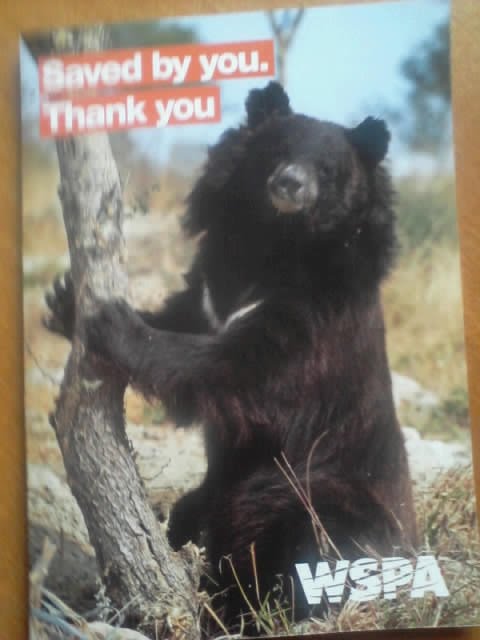
This is the wonderful 'thank you' communication I received from WSPA. A Bear's life saved because of my support.

On my 'tingle o metre' it ranked pretty high. It brought a tear to my eye, a smile to my face and a sense of pride in what had been achieved for Chowti and the other bears who have been saved from a life of pain and misery.

So what was it about this card that genuinely moved me? And it did. After all, it is clearly a mass produced card, it arrived in a standard windowed C5 envelope, the back of the card was the address carrier - no handwritten outer. On the surface of it, you'd think that actually it wouldn't 'feel' that special, but it was.

Here's why:
  • It was unexpected. Not the success per se - but as I often receive appeals from WSPA and updates through their supporter magazine, I wasn't expecting this stand alone piece relaying this great news. Unexpected and welcome.
  • The execution of it. Despite listing the things above that could be seen to detract from the personal nature of the piece I actually liked the fact that it was a good, honest piece of direct mail. At the end of the day the strongest and most important element about it was the story and the transformation that WSPA and supporters like me had helped bring about. The creative show cased that brilliantly.
  • The photograph of Chowti on the front said it all - beautiful image of a beautiful creature freed from its tormentors. A great photograph paints a thousand words and this one certainly did.
  • It was a 'thank you' and nothing else - not a thank you and... or a thank you but... just a thank you and as I have mentioned before that it is quite a rare thing.
  • It was supporter focused. From the thank you strap line on the envelope, headline on the card, and the short but emotive copy inside. It was about me, the supporter. This came across loud and clear but also sounded very heartfelt. After all, It is easy enough to re-focus copy to include a few more 'yous' than you would normally do but it takes more than that to make it sound genuine and genuinely supporter focused.
  • I opened it and read it - and this is probably the most important point. That is how I know the copy was donor focused and a heartfelt thank you, that the photo was lovely. And that Chowti is now free from pain a suffering.
So why did I open and read it? Since picking up the telephone many year's ago in response to their TV ad, I have never been disappointed. I signed up because I wanted to help end the torture and torment of animals - particularly the bear in the ad. Since then I have never doubted their commitment to what they were 'selling'. They are delivering on what I signed up to..it is as simple as that.

So of course the elements above that made the piece itself great are a good starting point, the harder part is obviously getting such communications opened in the first place. And to do that we need to ensure that we are doing what we say we will and proving it - from recruitment all the way through the on-going communications.

The card now occupies pride of place on my dresser - with photos of my family, friends and baby son. That is how much I loved it.

Thank you for stopping by!

Monday, 14 February 2011

Are your communications coming unstuck?

Imagine if you will a scenario where you have finally had time to properly read the mail from the charities that you support. You are motivated to respond to the latest request for money. You go and get your wallet and fill in the donation form with your credit card details or find your cheque book and write out your cheque. So far so good.

You then go on to enclose the donation form in the Freepost envelope provided and find one or both things:
  • That you need to be skilled in origami to get the donation form to fit into the envelope provided and have to fold it several ways to get it in
  • That after (finally) enclosing the donation form you go to lick the envelope and it doesn't stick so you then have to go off to find some glue or Sellotape
Now this is another pet hate of mine. Because we as fundraisers should be breaking down the barriers to giving not creating them. And though the two issues above are not big things they could in reality make the difference between you receiving the donation or not! And I know because I have experienced them both this weekend.

I wonder, how many Freepost envelopes remain unposted because someone couldn't find or be bothered to find the Sellotape that they were going to dig out later ..but never did.

So please, a little plea. If you are going to provide envelopes to aid response then make sure they stick - just test them yourself. It isn't about buying an expensive envelope it is about providing one that does its job.

As regards the donation form, there has been much written about them, but again, it's about functionality and in the same way you look at what information is vital to capture on a donation or response form and making it as easy as possible for the person completing it - another check is whether it easily fits into the envelope you have provided. Simple.

After all, this is one occasion where 'pushing the envelope' probably doesn't apply.

Thank you for stopping by!

Friday, 4 February 2011

When cracks begin to show

A little pet hate of mine both personally and professionally is when communications pretending to be personal are obviously mass produced because you can quite literally see the joins!

What I mean by that is that the personalisation i.e. name and address etc is in another font to the main bulk of the email or that the pre
-printed backs of letters do not match the lasered fronts - to me it's sloppy and it can be undermining. Particularly if you have spent time and energy ensuring that the copy and messaging is right.

Now the question is do supporters notice? I can only speak for myself here.. but I do. Does it make me want to cancel my support.. No..(well not immediately) that would be an extreme reaction - but it does make me think about how much care has gone into the letter and thus how much they care about my support.

However, I have realised recently that I am more forgiving of smaller, lesser known organisations than the bigger ones and also on whether the communication is an ask or in fact a thank you.

However, my point is, there is no excuse for such lack of care in supporter communications. Most supporters know deep down that the same letter is going to many people not just them... but we can still make the effort to ensure that the chances of them being reminded of this is reduced.

Such examples as mentioned above are easily ironed out: during the test phase for emails and the laser and proof stage for letters. We just need to care enough to ensure that such things don't go out with such silly errors.

After all we want to inspire and engage our supporters. Not make them question whether we care or not.